
Four-point contact bearings (QJ) – advantages, design and applications
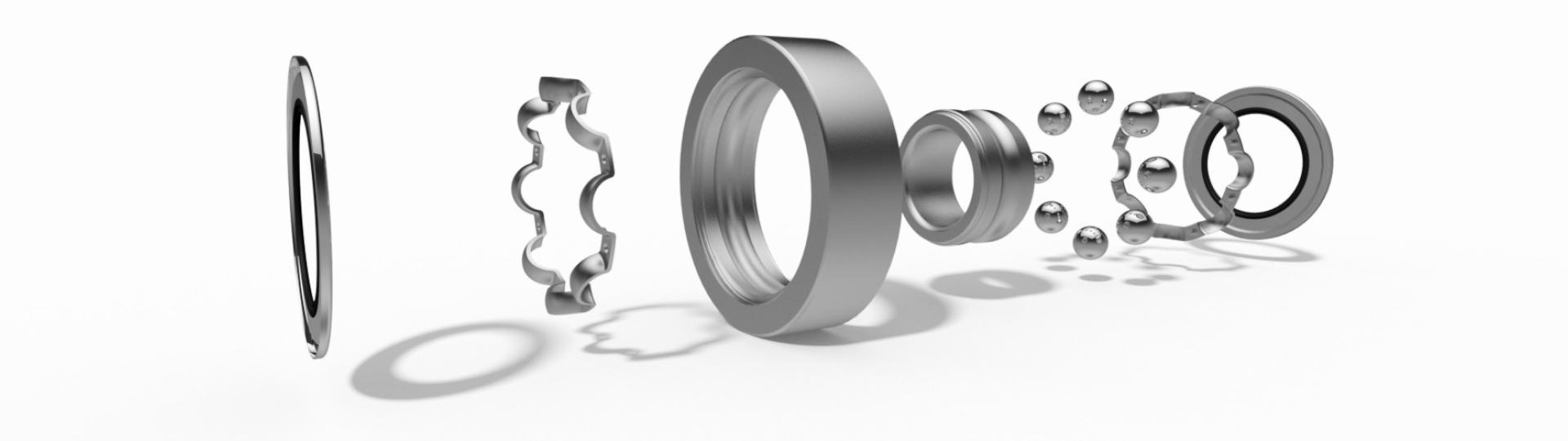
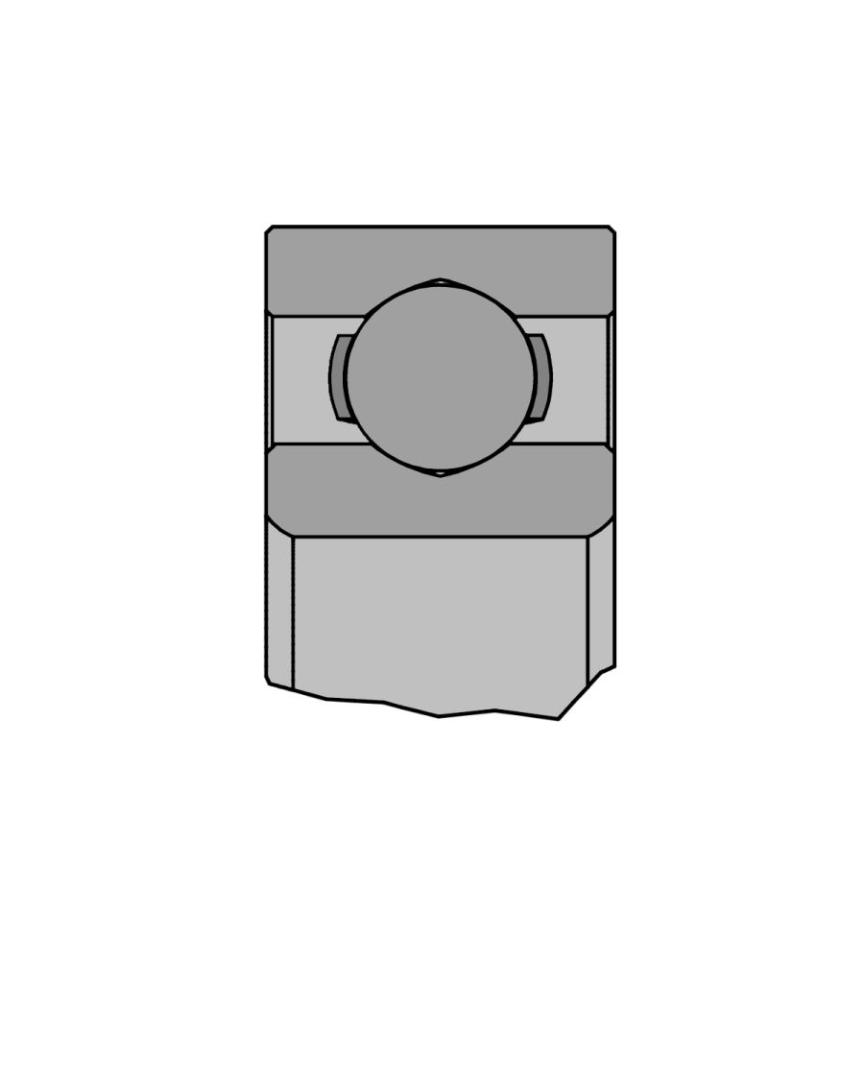
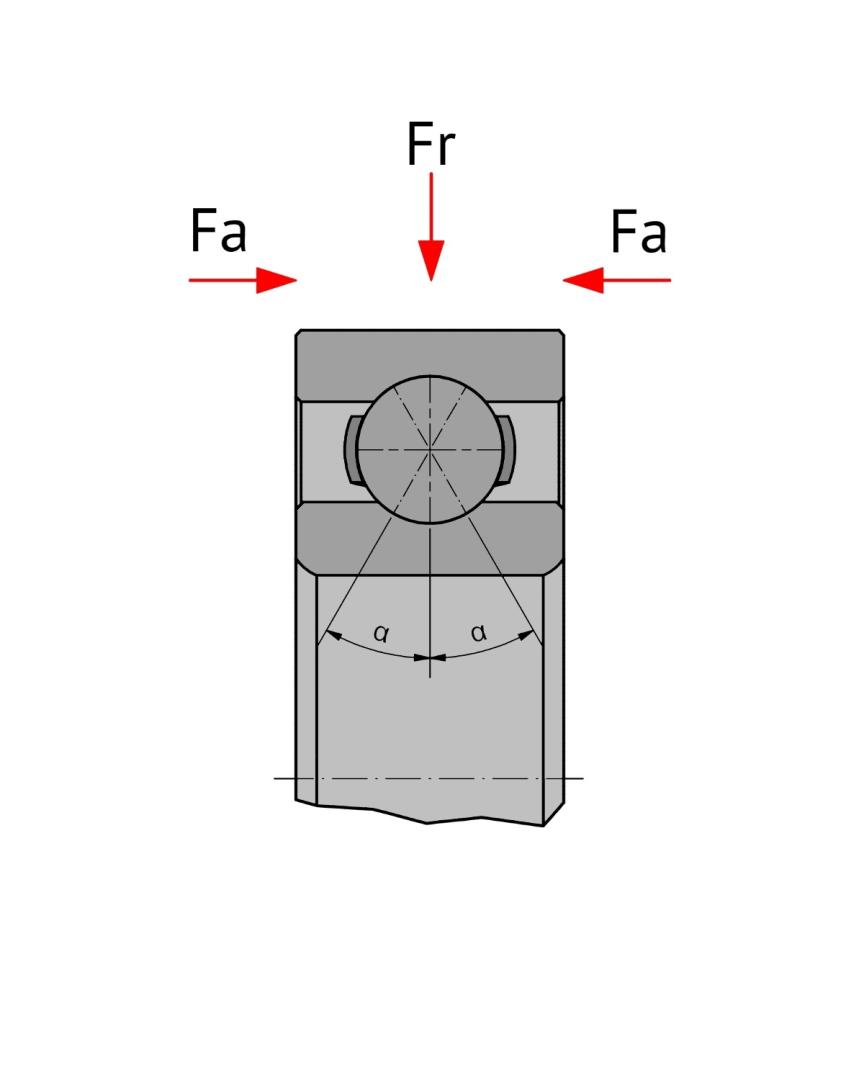
Four-point contact bearings – often referred to as QJ bearings – are single-row ball bearings with a split ring design and a raceway geometry that creates contact at four points under combined load. This allows them to support axial loads in both directions while also carrying limited radial loads. Compared with two angular contact ball bearings arranged back-to-back, four-point contact bearings provide a compact bearing solution with high axial load capacity.
Due to the split inner ring, more rolling elements can be inserted. This increases load capacity and makes four-point contact bearings particularly suitable where installation space, ease of assembly and bidirectional axial load support are critical.
Are you looking for a four-point contact bearing for your application?
We support you with bearing selection, material choice, sealing, cage design and lubrication – from technical clarification to a customised solution.
Request a four-point contact bearing Call us directly: +49 (2053) 497 – 36
Advantages of four-point contact bearings at a glance
- Support axial loads in both directions – ideal for reversing loads
- Compact design – often more space-saving than two separate angular contact ball bearings
- Easy assembly thanks to the split ring design
- High load capacity due to the design-related امکان to use more rolling elements
- Suitable for higher speeds with the correct lubrication and sufficient axial minimum load
Four-point contact bearings vs. angular contact ball bearings
A four-point contact bearing can often replace two angular contact ball bearings arranged in opposition. This saves installation space, reduces the number of components and simplifies assembly. This design is especially beneficial for applications with predominantly axial loads in both directions.
However, where very high combined loads, maximum rigidity or specific system requirements are involved, a double-row angular contact bearing arrangement or a combination of a four-point contact bearing and a support bearing may be the better choice.
When is a four-point contact bearing the right choice?
Suitable for: screw drives, rotary units, gearboxes, spindles, turntables, packaging machinery, machine tools and applications with predominant axial loading and limited installation space.
Less suitable for purely radial loads: In such cases, deep groove ball bearings are often lower in friction and more economical. For radially dominated applications, we recommend for example full complement rolling bearings.
Load, axial minimum load and speed
As the axial load increases, the possible radial load capacity of four-point contact bearings decreases. For smooth running at speed, a sufficient axial minimum load is often advisable in practice. A typical practical value in continuous operation is: Fa ≥ 1.2 · Fr.
Whether this value is suitable for your application depends on factors such as speed, lubrication, mounting position, fits and temperature. For demanding applications, the bearing arrangement should always be checked specifically for the application.
Accuracy, internal clearance and Q / QJ designs
- Tolerances: generally class P0 according to DIN 620-2; higher precision classes available on request
- Internal clearance: standard CN according to DIN 620-4; C3 or C4 possible for higher temperatures or special fits
- QJ bearings: standard design with split inner ring and a typical contact angle of 35°; QJ12 series 45°
- Q bearings: design with split outer ring and a typical contact angle of 23°; Q12 series 45°
Seals, cages, materials and designs
- Sealing: depending on the application with shields or seals; in addition, special sealing systems can be implemented for high sealing performance, aggressive media or limited installation space
- Cages: polymer or metal cages depending on speed, temperature and operating conditions
- Materials: standard material 1.3505 / 100Cr6 with a minimum hardness of 58 HRC; additionally, corrosion-protected designs, stainless steel versions or hybrid bearings are possible
Typical applications for four-point contact bearings
- Linear drives and screw jack gear units
- Rotary tables, rotary units and small slewing rings
- Packaging machinery and machine tools
- Conveyor technology and special machinery with reversing axial loads
Four-point contact bearings as a standard or customised solution
Whether you need a standard QJ bearing or a customised solution, we support you in selection, adaptation and technical optimisation.
Configure your four-point contact bearing now Get advice at +49 (2053) 497 – 36
FAQ about four-point contact bearings
What is a four-point contact bearing?
A four-point contact bearing is a single-row ball bearing with a special raceway geometry. Under combined load, four contact points are created between the ball and the raceway. This allows the bearing to support axial loads in both directions as well as limited radial loads.
What is the difference between Q and QJ?
QJ bearings generally have a split inner ring, while Q bearings have a split outer ring. There are also differences in contact angle and, depending on the design, in separability and self-retaining properties.
When is a four-point contact bearing preferable to an angular contact ball bearing?
If axial loads must be supported in both directions and installation space is limited at the same time, a four-point contact bearing is often the better choice. In many cases, it can replace two angular contact ball bearings arranged in opposition.
What does DIN 620-4 mean for four-point contact bearings?
DIN 620-4 defines internal clearance classes such as CN, C3 or C4. The correct clearance is selected depending on fit, temperature, speed and the required running characteristics.
What minimum load should be considered for four-point contact bearings?
For smooth running at speed, a sufficient axial minimum load is often advisable in practice. A typical empirical value is Fa ≥ 1.2 · Fr. However, the actual design should always be checked for the specific application.
Where are four-point contact bearings used?
Typical applications include screw drives, screw jack gear units, rotary tables, packaging machinery, machine tools, conveyor technology and special machinery with reversing axial loads.
Related topics

Your contact person
-
Roller bearings sales
-
+49 (2053) 497 - 36
-
Roler bearings
-
+49 (2053) 497 - 0
-
Opening hoursMo-Do.: 08:00 - 16:00
Fr.: 08:00 - 14:45
-
Delivery timesMo-Do.: 06:00 - 13:30
Fr.: 06:00 - 11:00
oder nach Absprache